Locations
Service areas
Explore piano hire in Melbourne and the named regional areas. Tell us the actual venue and postcode so we can confirm whether the proposed delivery and placement can be arranged.
Black, white and clear grand pianos. We confirm availability and arrangements for each booking.
At a glance
What matters for your hire.
Use the actual suburb and postcode to check the location through the booking process, and discuss anything uncertain with the team. A region label or accepted postcode is not a physical access approval. Supply the venue, room, dates and transport constraints so the location and the complete delivery-and-collection arrangement can be considered together.
The collection
Find your grand piano.
Explore the instrument as well as its finish. We can talk through the right option for your plans and dates.
Studio visualisations. Date availability and venue arrangements are confirmed separately.
At a glance
Check the location in layers
Identify the location
Use the actual suburb and postcode through the proper enquiry process.
Confirm venue permission
Ask about outside instruments and the intended room.
Describe the full route
Provide current facts for specialist access assessment.
Set both transport periods
Connect delivery and collection to venue operating times.
Retain the agreed arrangement
Check later location or room changes before relying on them.
Let’s talk about your hire
Have a date or venue in mind?
Tell us the occasion, the piano and the details you know. We can help work through the rest.
The practical details
Plan your hire with confidence.
Explore the parts that matter to your plans. If you’re unsure, we can talk them through with you.
A little more about this hire
A service-area question has two parts: whether the location can be considered for the hire and whether the instrument can be delivered to its intended position under workable arrangements. A suburb or region name does not answer both. Begin with the actual location, proposed dates and room, then provide the information needed to assess the complete request.
Piano Hire Australia’s current public service is centred on Melbourne. This page also directs you to planning information for the named regional options under consideration in the booking arrangements: the Yarra Valley, Mornington Peninsula, and Barwon Heads, Torquay and Anglesea. Those regional pages do not establish blanket coverage of every surrounding place. Confirm your particular location through the booking or enquiry process.
Explore the topics on this page
Start with the real location rather than a broad label
The most useful first description identifies the place where the piano would be used. A broad term such as Melbourne, the peninsula or the valley may be a convenient way to describe an event, but it leaves the booking team without the exact location needed for assessment. Begin with the suburb and postcode, then provide the full venue information through the proper booking or enquiry channel.
Read the detail about Start with the real location rather than a broad label
Do not enter private address or contact details into the planning tool on this page. It is designed to prepare a general brief locally in your browser, not to validate a delivery address or submit a booking. Use the dedicated process when sharing the information required for the actual request. The distinction keeps the planning outline useful without treating it as a coverage checker.
If the venue is still being chosen, say so and keep possible locations separate. A confirmed arrangement for one site should not be interpreted as confirmation for another nearby property. The team needs to assess the actual location, dates and access rather than an approximate point on a map. Clear location information is the foundation for the rest of the conversation.
Check that the venue name and location details refer to the same site. Some organisations operate more than one building, and a familiar venue name may not identify the entrance or room being booked. Confirm the exact site through the appropriate enquiry process, then keep that information with the assessed arrangement. This avoids treating an approval for one premises as though it applies to every location operated under the same name.
Understand what the Melbourne service description means
The current public website describes service in Melbourne and greater Melbourne. That is a starting point for an enquiry, not a statement that every address has identical delivery arrangements. The particular postcode, venue requirements and proposed hire still need to be considered through the booking process. Do not assume that a familiar suburb name removes the need to provide the actual details.
Read the detail about Understand what the Melbourne service description means
Melbourne locations can present very different operating conditions. A residence, a studio and a managed event venue may have different entry arrangements, access hours and placement requirements. Those differences are relevant even when the sites are close together. The useful information concerns the actual movement and room, rather than a general description of an area as easy or difficult to reach.
This page does not extend the current offer to another city merely because the business name includes Australia. If your request falls outside the current service, ask the team directly rather than relying on a domain name, an old link or a general search result. An enquiry can establish what can be considered without turning an unconfirmed location into advertised coverage.
Use regional pages as planning guidance, not boundary maps
The Yarra Valley, Mornington Peninsula and Barwon Heads, Torquay and Anglesea have separate planning pages in this first set of guides. They help organise the questions that can arise for a hire in those named areas. They do not approve every town, property or venue that somebody might associate with a regional label. The exact location remains part of the booking assessment.
Read the detail about Use regional pages as planning guidance, not boundary maps
A place may be described differently in a venue’s marketing material, its postal address and everyday conversation. Use the actual suburb and postcode rather than deciding that a nearby place belongs inside a particular service option. If the booking process does not resolve the question clearly, contact the team with the relevant details. Do not change the location description merely to make it fit an option.
A regional guide can also help prepare timing and venue questions, but it should not be read as evidence of a past job or a relationship with a named venue. Public information about a region is not an instrument-delivery permission. The final arrangement needs to connect the real address, the intended room and the actual requirements for the booked date.
Separate postcode eligibility from physical access
A postcode can help the booking process identify a location, but it cannot describe the route into a building. An address may fall within an area considered for hire while the proposed placement still needs detailed assessment. Keep those questions separate. Passing a location step is not permission to assume that a piano will fit through an entrance or reach a particular floor.
Read the detail about Separate postcode eligibility from physical access
Describe the complete route from the permitted unloading point to the intended position. Include known steps, level changes, lifts, turns and controlled access arrangements. Photographs and the venue’s current information can help the specialist team assess the movement. The customer is not expected to certify clearance or select a moving method from the information on this page.
If the route is uncertain, record the uncertainty. A statement such as access to be checked is more useful than an unsupported assurance that there should be no problem. The team can then identify what information is needed. This approach allows location research and practical assessment to progress together without confusing a postcode result with a finished delivery plan.
Describe the venue’s permissions and operating rules
A venue may require permission for an outside instrument or impose rules on supplier access. Ask the relevant representative about the proposed piano, the room and the periods when delivery and collection can occur. A general event booking does not necessarily answer these questions. The venue’s own requirements need to be understood alongside the piano team’s assessment.
Read the detail about Describe the venue’s permissions and operating rules
If loading facilities, lifts or staffed entries must be reserved, identify who is responsible for arranging them. The instrument booking does not automatically make a separate reservation with the building. Confirm the current process and pass the relevant information through the enquiry route. Avoid relying on a previous supplier’s experience if the venue has not confirmed that the same conditions apply to your event.
Public venue information can help identify useful questions, but it should not be treated as an approval for your particular hire. Room use, access and operating arrangements can change. Where a venue has its own piano, discuss that fact with the event organiser and performer as part of the broader music plan. The existence of a venue instrument does not itself approve or prohibit an outside hire.
Give delivery and collection equal attention
The location may operate differently at the beginning and end of the hire. A loading entrance available during weekday setup might have different access after an evening event, and the person receiving the instrument may not be present at collection. Ask about both legs of the arrangement before choosing dates and times. One access description should not silently stand in for two different situations.
Read the detail about Give delivery and collection equal attention
State when the room is available, when the piano must be ready and when the venue needs the space cleared. A transport window is not an exact appointment unless the specific arrangement has been agreed. If the location imposes a narrow period, describe it directly so the team can assess the request rather than discovering the constraint close to delivery.
Same-day hire refers to delivery and collection on the same booked date. It does not mean the instrument can be delivered immediately on the day of an enquiry. The normal online flow requires advance notice, and unusual timing needs discussion. The location plan should therefore connect coverage, access and timing instead of treating each as an unrelated checkbox.
Match the instrument and use to the location enquiry
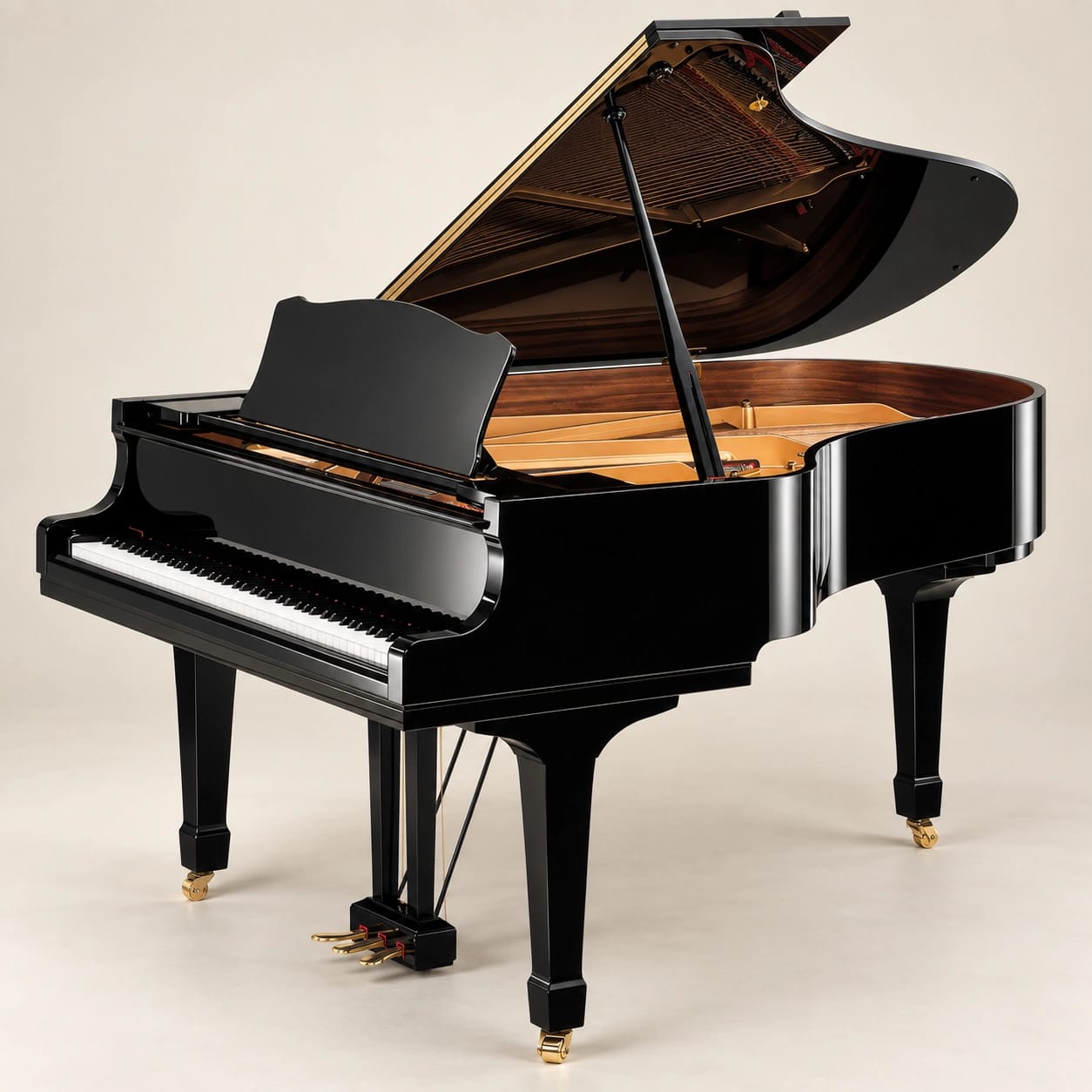
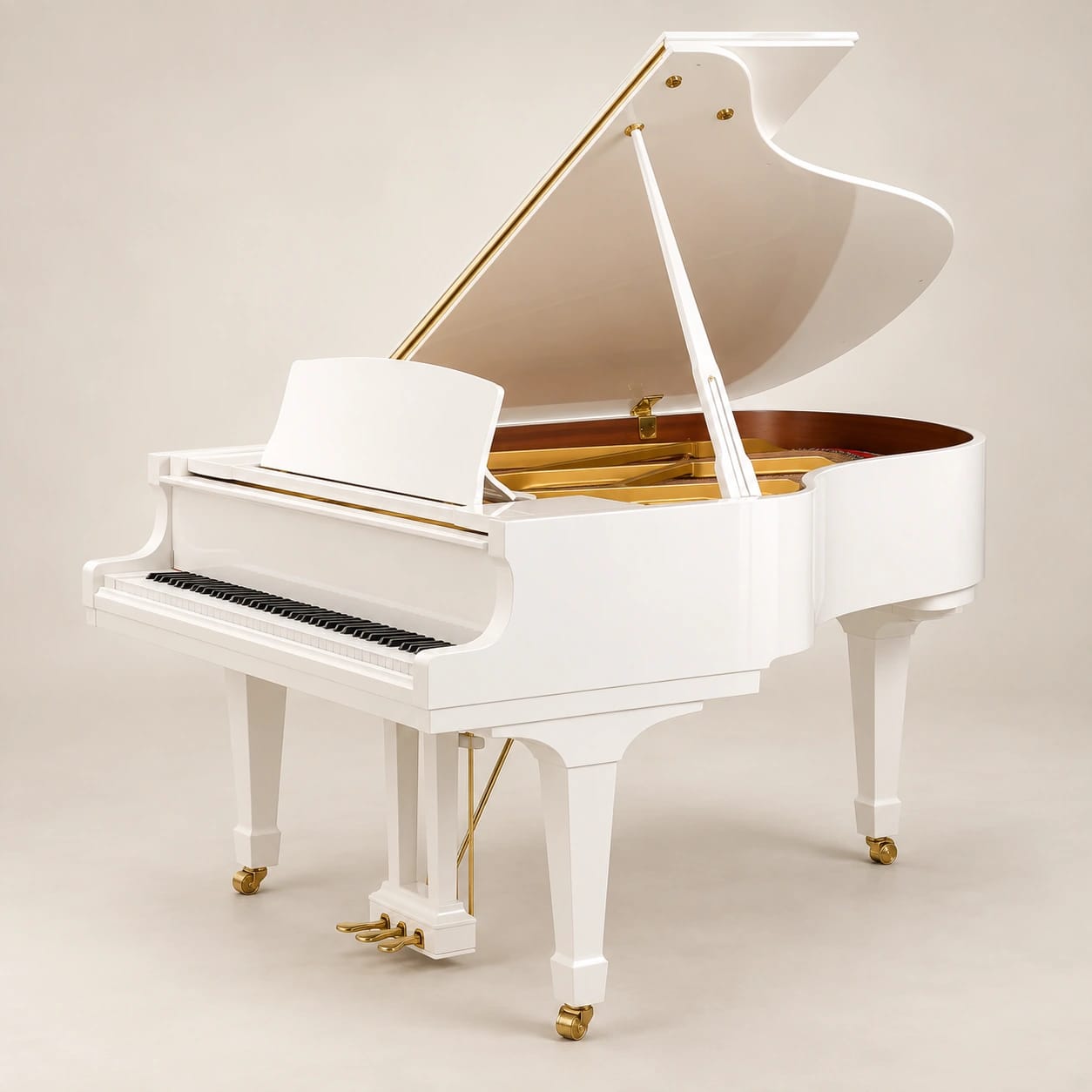
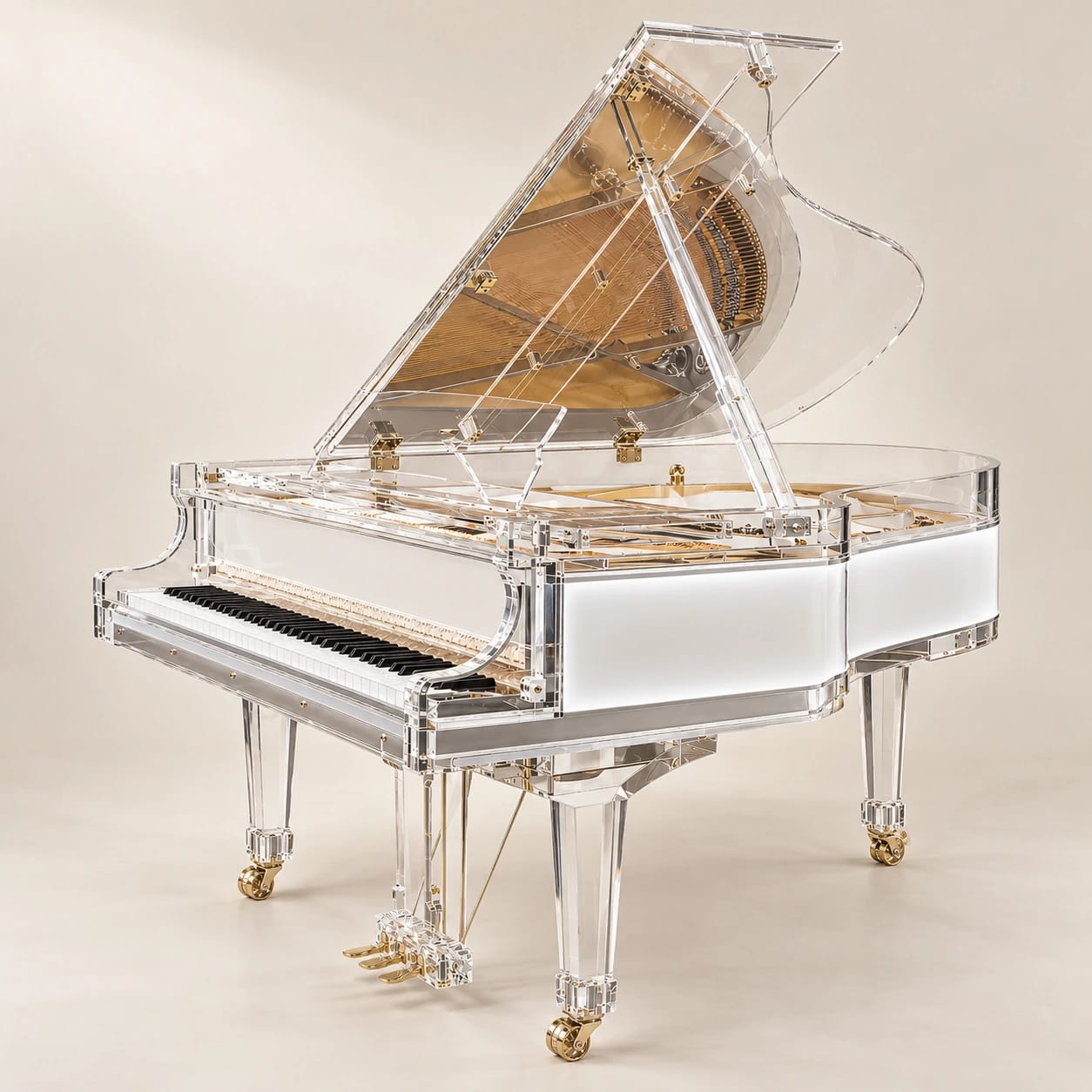
The current collection contains three grand pianos: the white Stenberg 152, black Yamaha C3 and clear Teschendorf M170. Identify the preferred model or the choice still being considered when asking about a location. A general location enquiry is more useful when the team also understands what instrument and use it is being asked to assess.
Read the detail about Match the instrument and use to the location enquiry
Explain whether the hire is for an event, a performance, photography or a display period. The use can affect when the piano needs to be ready, how long it will remain and which people need to approve the instrument. It does not remove the need for physical assessment. A piano used only for display still needs an agreed route, position and handling arrangement.
Do not infer suitability for unusual placements from the existence of a regional or event guide. Outdoor, beach, rooftop and other special requests require individual consideration. A reference photograph can communicate an idea, but it is not proof of permission or safe access. State the actual proposal and ask what can be assessed before making the location central to the final plan.
Keep pricing and coverage questions distinct
Use the live booking system or individual quote for current amounts associated with the actual hire. A regional label does not provide a reliable fixed price on its own, and this guide does not reproduce transport or access charges. The selected instrument, dates and assessed requirements need to form one coherent proposal before the total can be reviewed meaningfully.
Read the detail about Keep pricing and coverage questions distinct
If a location-related amount or condition is unclear, ask what it covers. Keep the response with the current quote so the person approving the booking can understand the scope. Do not substitute a remembered amount from another event or an old screenshot. Two bookings in the same general area may describe different instruments, occupied periods or practical arrangements.
A change of venue should be discussed even when the replacement is nearby. The postcode, route, room and permitted times can differ. Contact the team with the revised information and wait for the updated arrangement to be confirmed. The original location assessment should not be carried across automatically simply because the event’s purpose and date remain unchanged.
Prepare a location brief that makes the next check easier
The location brief builder on this page helps you collect the non-personal information needed for an initial discussion. Record the suburb or region, venue type, intended room, known access issues and timing constraints. It creates a copyable outline only. It does not look up postcode eligibility, calculate a delivery cost, send information or approve a route.
Read the detail about Prepare a location brief that makes the next check easier
Review the outline with the person responsible for the venue before using the normal enquiry process. Ask them to confirm the facts within their control and identify anything that still needs a decision. Where more detailed information is required, provide it through the appropriate booking channel. The objective is to avoid repeated broad questions by making the actual location and unresolved points clear.
Once the location and instrument arrangements are agreed, keep the confirmation with the event or display plan. Check any later change against that record, including a different room, a revised access route or another collection period. A service-area guide is most useful when it leads to an accurate address-specific arrangement, rather than being treated as a blanket guarantee based on a map or a familiar place name.
Want to organise your notes first?
Your enquiry
Build a location enquiry brief
Prepare a non-personal summary. This tool does not validate a postcode or determine whether a piano will fit.
Your notes stay in this page. Nothing is sent or saved automatically.
0 / 4,000 enquiry-note characters. Only answered fields and selected checks are included.
Read or select your brief
Your location enquiry outline

Area or suburb: To confirm
Venue type: To confirm
Room and use: To confirm
Known access questions: To confirm
Timing constraints: To confirm
Location status: To confirm

Planning checklist
[ ] The actual suburb and postcode will be checked through the booking process.
[ ] Regional guidance is not being treated as blanket coverage.
[ ] Venue permission is separate from location eligibility.
[ ] The complete route needs specialist assessment.
[ ] Delivery and collection restrictions are both recorded.
[ ] The requested model and use are identified.
[ ] Any room or venue change will be raised before relying on the original plan.

Planning notes only. Piano availability, access and arrangements need confirmation before booking.
Good to know
Your questions, answered.
Does a postcode accepted by the booking form approve the whole hire?
No. Location eligibility and the physical delivery arrangement are different questions. The exact room, access route, dates and intended use still need to be assessed. Do not treat an accepted postcode as a guarantee that the instrument can reach a particular floor or be placed in a proposed setting.
Do the regional pages mean every nearby town is covered?
No blanket boundary is established by a regional guide. Use the actual suburb and postcode and discuss uncertainty through the booking or enquiry process. A venue’s marketing description or proximity to a named region is not enough to confirm service for its particular address.
Can I enquire before choosing the final venue?
Yes. Explain that the location is provisional and keep the alternatives clearly identified. The team can tell you what information is needed for assessment. Do not rely on an arrangement discussed for one location as approval for another venue once the final choice is made.
What happens if we change rooms within the same building?
Tell the team about the new room and any changed route or timing. A room change can alter the movement and placement requirements even though the address stays the same. Wait for the revised arrangement to be considered rather than assuming the original access assessment applies everywhere in the building.
Let’s talk about your hire
Tell us what you’re imagining.
Tell us the occasion, the piano and the details you know. We can help work through the rest.