Prepare the performer brief
Performer and touring piano brief
Create a clear piano brief for your performer or production team. Separate essential requirements from preferences, identify the proposed instrument and preparation, then ask us about the arrangements for your performance.
Black, white and clear grand pianos. We confirm availability and arrangements for each booking.
At a glance
What matters for your hire.
Name the proposed piano, explain the performance format and separate essential requirements from preferences. State any tuning or preparation request, the first required use, the stage-position proposal and who can approve a change. Ask for explicit responses to unusual requirements rather than assuming a hire confirmation accepts them. Piano Hire Australia’s current models can be considered by the performer, but neither a product description nor this brief certifies rider compliance, room suitability or access.
At a glance
From musical requirement to accepted brief
Describe the music
State the performance task and first required use.
Classify each request
Separate essentials, preferences and open questions.
Assess the offered model
Obtain acceptance of the exact proposed instrument.
Confirm preparation and position
Resolve specific requests with the supplier and venue team.
Issue the final brief
Keep accepted decisions and change authority visible.
Let’s talk about your hire
Have a date or venue in mind?
Tell us the occasion, the piano and the details you know. We can help work through the rest.
Your enquiry
Performer piano brief builder
Create the instrument part of an advance. It does not certify rider compliance, reserve stock or authorise unusual use.
Your notes stay in this page. Nothing is sent or saved automatically.
0 / 4,000 enquiry-note characters. Only answered fields and selected checks are included.
Read or select your brief
Performer piano requirements

Performance format: To confirm
Essential requirements: To confirm
Preferences and alternatives: To confirm
Proposed model: To confirm
Preparation request: To confirm
Playing position and first use: To confirm
Approval and change role: To confirm

Planning checklist
[ ] Musical decision-maker identified
[ ] Essentials separated from preferences
[ ] Exact model considered by the performer
[ ] Unusual preparation requests explicitly answered
[ ] Position proposal sent for proper assessment
[ ] Audio and accessories have separate owners
[ ] First required use includes rehearsal or soundcheck
[ ] Substitution approval process recorded

Planning notes only. Piano availability, access and arrangements need confirmation before booking.
The practical details
Plan your hire with confidence.
Explore the parts that matter to your plans. If you’re unsure, we can talk them through with you.
A little more about this hire
A useful performer piano brief says what the player needs to do, which instrument is proposed and which details still require an answer. It should be specific enough for a hire supplier to respond without turning preferences into promises or burying the important requirements inside a long technical rider.
Use this guide to prepare the instrument part of a performance advance. It suits a pianist writing their own requirements or a producer collecting them on the player's behalf. The emphasis is musical acceptance and clear communication. Venue access, transport and commercial approval remain separate decisions that the production coordinator needs to join to the brief.
Explore the topics on this page
Describe the performance before specifying equipment
Open with a short account of the musical task. State whether the piano carries a solo performance, accompanies a singer, joins an ensemble or appears for one section of a larger show. Include any rehearsal, soundcheck or recording use that affects the instrument requirement. This context helps the supplier understand why a request matters without having to infer it from a set list.
Read the detail about Describe the performance before specifying equipment
Identify the person who can make the musical decision. It may be the pianist, musical director or an authorised representative. A production assistant can collect the information, but should not silently approve a different instrument or preparation on someone else's behalf. Record the decision role rather than filling a shared planning tool with personal contact details.
Use ordinary, precise language. “The pianist needs to approve the offered model before confirmation” is clearer than “top-tier concert instrument essential” if the latter has no agreed meaning. Where a technical term is necessary, explain the requirement well enough that a response can be yes, no or a request for clarification.
Keep irrelevant rider material out of the instrument brief. Catering, dressing-room and general production requirements may belong elsewhere in the advance. A focused document makes it easier for the supplier to spot the piano-specific questions and for the performer to verify that their essentials have survived the handover.
Separate essential requirements from preferences
Create three categories: required for acceptance, preferred if available, and open questions. Put each request in the appropriate category with the performer's agreement. The distinction prevents a colour preference from being treated as a non-negotiable musical requirement, or a genuine requirement from being dropped because it looks like descriptive language.
Read the detail about Separate essential requirements from preferences
For an essential item, state how acceptance will be established. A named model might need the performer's approval; an unusual preparation request needs a direct supplier response. Do not mark an item accepted merely because it appears in an email attachment. A clear reply or agreed booking scope should identify what has actually been confirmed.
For a preference, say whether an alternative can be considered and who decides. Avoid listing a substitute as pre-approved unless the performer has genuinely accepted it. A useful brief leaves room for discussion without letting the organiser make a musical judgement they are not authorised to make.
Keep open questions separate from requirements. “Is optional on-site tuning available within this schedule?” asks for information; it is not a statement that the service has been booked. This small distinction makes the document easier to read during a busy advance and reduces the chance of a requested item becoming an assumed inclusion.
Give each essential requirement a concise reason if it is not obvious. The reason helps the supplier distinguish an artistic need from a copied rider clause and can reveal whether another proposal is worth asking the performer to consider. It should not become an invitation for the organiser to reinterpret or waive the requirement. If the performer changes their decision after receiving more information, record the revised requirement explicitly.
Before issuing the brief, ask the musical decision-maker to read the essentials as a complete set. Individually reasonable requests can still leave the intended result unclear when gathered from several messages. A short review of the combined wording lets the performer correct that ambiguity before it reaches the supplier. The finished document should make it possible to identify an unanswered requirement immediately, without searching through preferences or unrelated production notes.
Identify the exact instrument being considered
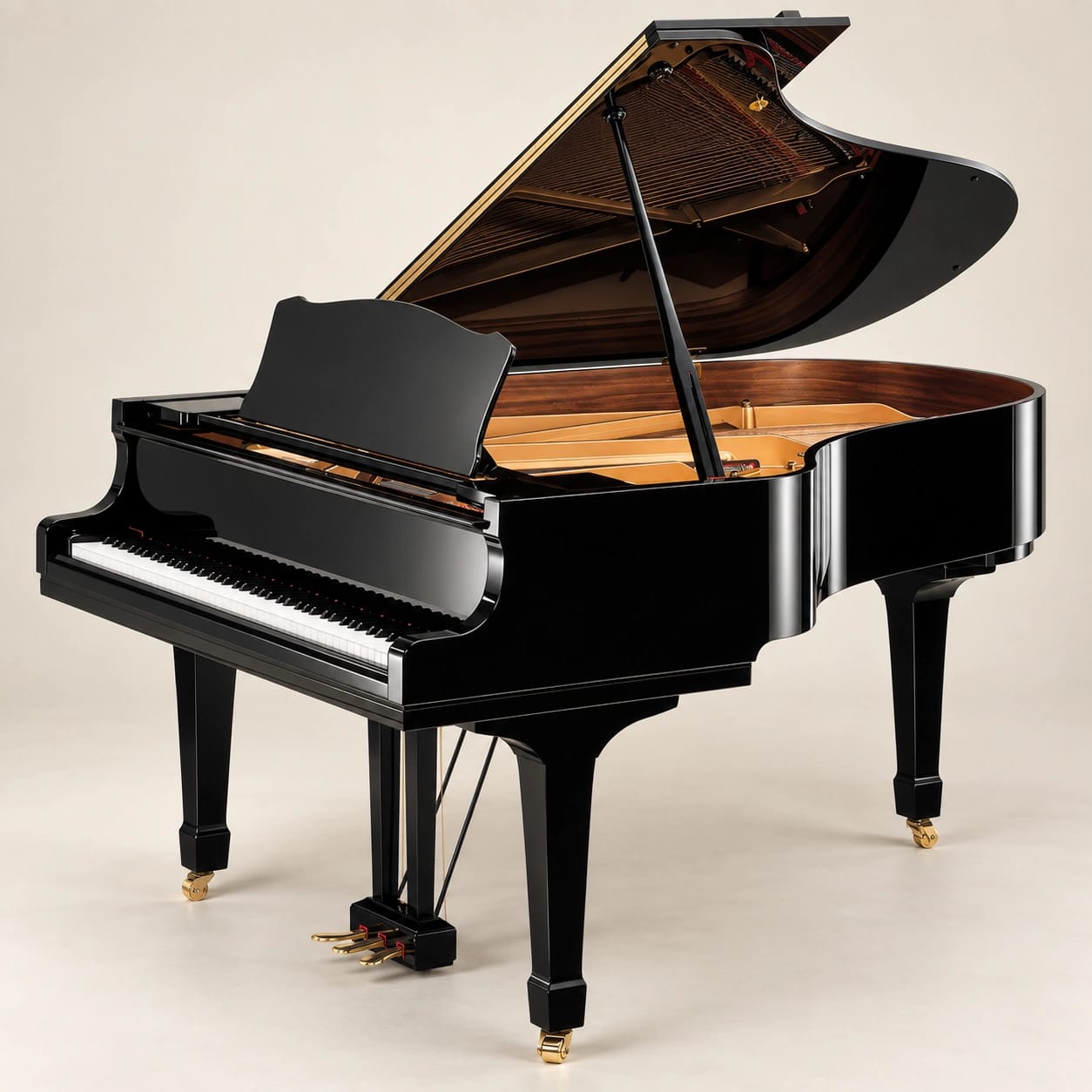
The current Piano Hire Australia collection is Gordon, the white Stenberg 152; Sebastian, the black Yamaha C3; and Oscar, the clear Teschendorf M170. Refer to the exact model and name in the brief so the performer and supplier are discussing the same instrument. Do not use “grand piano” as a complete specification when model acceptance matters.
Read the detail about Identify the exact instrument being considered
Ask the performer to assess the offered information against the musical task. A collection description can identify the model and finish, but it does not prove a particular tonal result, action preference or suitability for every programme. If more information is needed, make a specific request rather than filling the gap with an assumption.
A visual choice can be included as its own line. The production may want a particular finish for a stage design, while the musician prioritises the instrument. Those interests can be considered together, but the brief should not imply that one automatically resolves the other. State which decision is essential and which remains a preference.
If the proposed model changes, obtain renewed acceptance where required. Do not rely on a musician having approved “one of the grands” unless that was genuinely their decision. Keep the final model in the confirmed brief and update any stage plot or production document that refers to a different choice.
Write preparation requests as questions to confirm
Optional on-site tuning can be requested as part of the hire. State whether it is wanted and describe any particular musical requirement that needs discussion. If a reference pitch, timing request or other preparation matters, ask for an explicit answer. Do not assume that selecting a tuning option automatically accepts every specialist request in a rider.
Read the detail about Write preparation requests as questions to confirm
Avoid vague phrases such as “fully prepared to artist standard” unless the standard is described and agreed. They can conceal different expectations between performer, organiser and supplier. A concise list of the actual concerns gives the appropriate specialist something concrete to respond to and makes it easier to see what remains unresolved.
Raise unusual playing techniques, internal contact, objects, attachments or alterations before booking. The performer’s creative intention is not permission to change hired property. Explain what is proposed and wait for a clear response. If the request cannot be accommodated, the production needs to decide on an alternative rather than improvising during rehearsal.
Schedule preparation in relation to the actual first use. The instrument may be needed for a player check before soundcheck, or a rehearsal before the show day. Tell the coordinator about that sequence so they can ask the supplier what can be arranged. Do not promise a preparation outcome or a fixed timetable on the supplier's behalf.
Describe the playing position without certifying the space
Give the production team a proposed playing position and orientation. Explain what the performer needs to see: a conductor, other musicians, a cue light or the audience. These are useful requirements for the stage plan, but the final arrangement still needs to be reviewed against the venue, instrument and production setup.
Read the detail about Describe the playing position without certifying the space
Mark surrounding equipment and movement routes on the drawing. Include the areas required by other performers and any audio equipment the production intends to use. Do not reduce the planning task to the outline of the piano alone. The player, seating, access to the position and the rest of the performance all need to be considered by the responsible team.
Published model information is not a doorway or route-fit approval. The current access brief must go to the hire team and appropriate venue specialists, particularly where a lift, stairs or stage is involved. Do not calculate a safety margin from a model name or assume that an instrument fitting on paper establishes suitability for a floor or platform.
If the performer requests a different orientation after seeing the room, communicate the proposed change. The crew should not move the piano casually to satisfy a late preference. The aim is to agree a practical position through the responsible people, then let the performer concentrate on the music.
Keep audio and accessories visible as separate items
Ask the production team to list what it is providing around the piano. Seating, microphones, stands, reinforcement, monitoring, playback and recording equipment should each have a clear owner where relevant. Do not infer an audio package or performer service from an instrument hire. If an accessory is required, ask whether it is included and record the answer.
Read the detail about Keep audio and accessories visible as separate items
The performer can explain their monitoring or cue needs, while the sound team chooses and verifies the production approach. A piano supplier's product description is not a guarantee about the venue's acoustic response or the final mix. Put technical audio commitments with the people responsible for them instead of incorporating them as implied piano features.
For a recorded or streamed performance, say that recording is part of the project. The engineer and producer need to assess their own requirements and permissions. The instrument brief should describe the use accurately, while avoiding unsupported promises about recording suitability or broadcast quality.
Check that the final schedule gives the relevant teams access in the right order. Specialist placement, optional instrument preparation, performer familiarisation and audio work should not all be assigned the same moment. The brief supplies the performer's needs; the production advance turns those needs into a coordinated, confirmed sequence.
Define how substitutions and concerns will be handled
Agree a process for a proposed substitution before one becomes urgent. State which role must approve a change of model or preparation, how the request should be communicated and whether any alternatives have already been accepted. Do not write that a substitute is guaranteed or available unless the supplier has confirmed that arrangement.
Read the detail about Define how substitutions and concerns will be handled
For a concern during the player check, use a factual description. Explain what is happening, where it is noticed and whether it affects the planned performance. Contact the hire team through the agreed channel. Avoid diagnosing a mechanical issue or attempting an adjustment without the appropriate guidance and permission.
Keep the performer and production coordinator in the same conversation where possible. The performer can explain the musical concern, while the coordinator manages timing and communication with the venue. This prevents a technical question from being reduced to “the artist is unhappy” or a production pressure from being mistaken for authority to alter the instrument.
After a decision, update the brief. Record what was agreed and which earlier statement it replaces. A short version history is helpful when several people are advancing different dates, but it should contain actual decisions rather than a claim that every possible contingency has been solved.
Issue a brief that remains useful on show day
The final brief should be short enough to scan, even if the preparation behind it was detailed. Put the named instrument, essential requirements, accepted preparation and first required use near the top. Follow with the stage-position proposal, separate audio responsibilities and outstanding questions. Link the relevant collection information rather than copying a large specification table that can become stale.
Read the detail about Issue a brief that remains useful on show day
Give the document a clear version and date in your own production system. When an item changes, identify the difference rather than circulating an unexplained replacement. Ask the person responsible for the overall advance to confirm that the venue and supplier have the same current information.
Before the day, check that every required answer has actually arrived. A completed internal checklist is not a reservation, a rider acceptance or a venue approval. The final record should distinguish supplier confirmations from performer preferences and from production tasks that remain with your own team.
The brief builder on this page provides a structured starting point. It does not submit information, store personal details or certify that a model is suitable. Copy its output into your normal advance, add the specific responses received and keep the accepted version with the production documents.
The collection
Find your grand piano.
Explore the instrument as well as its finish. We can talk through the right option for your plans and dates.
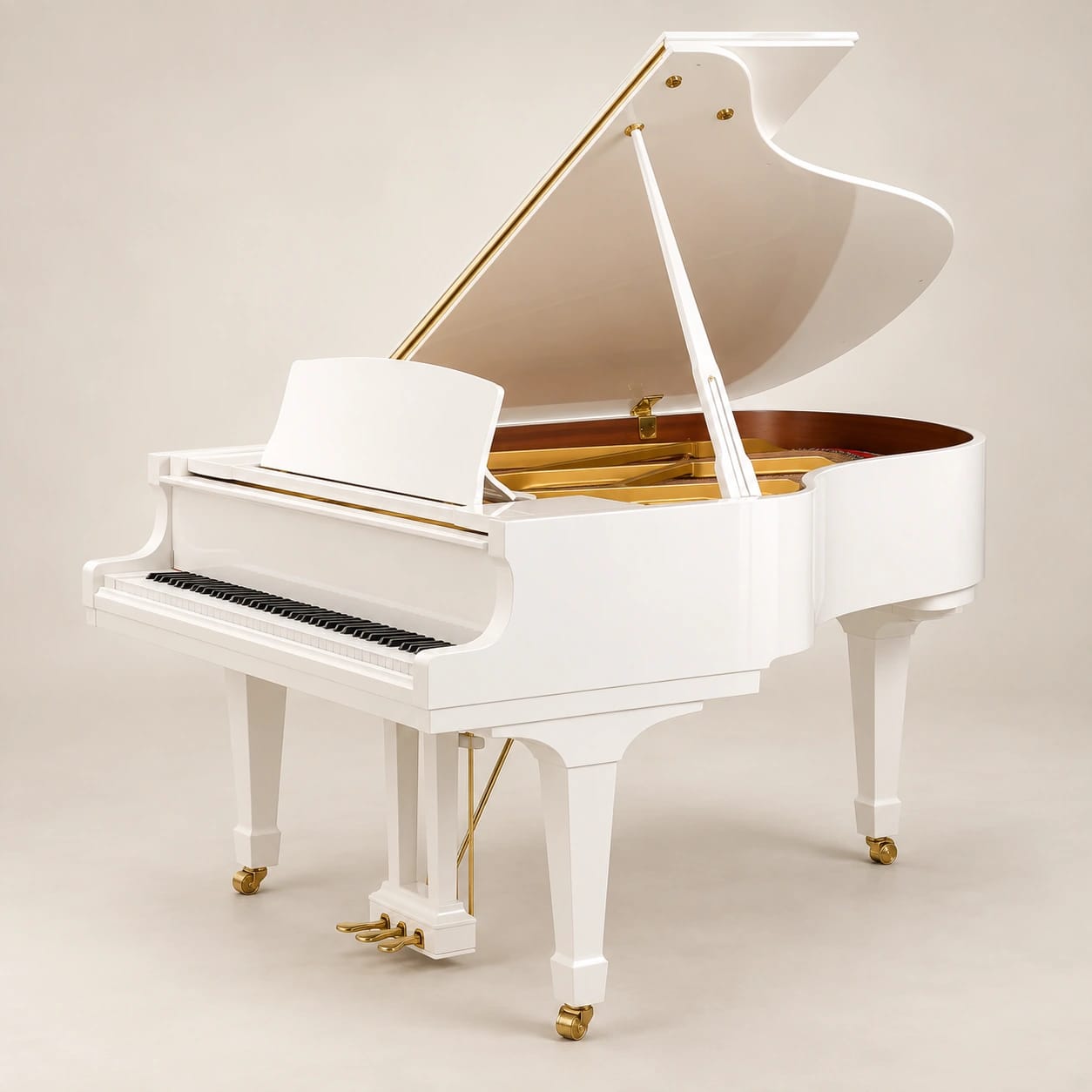
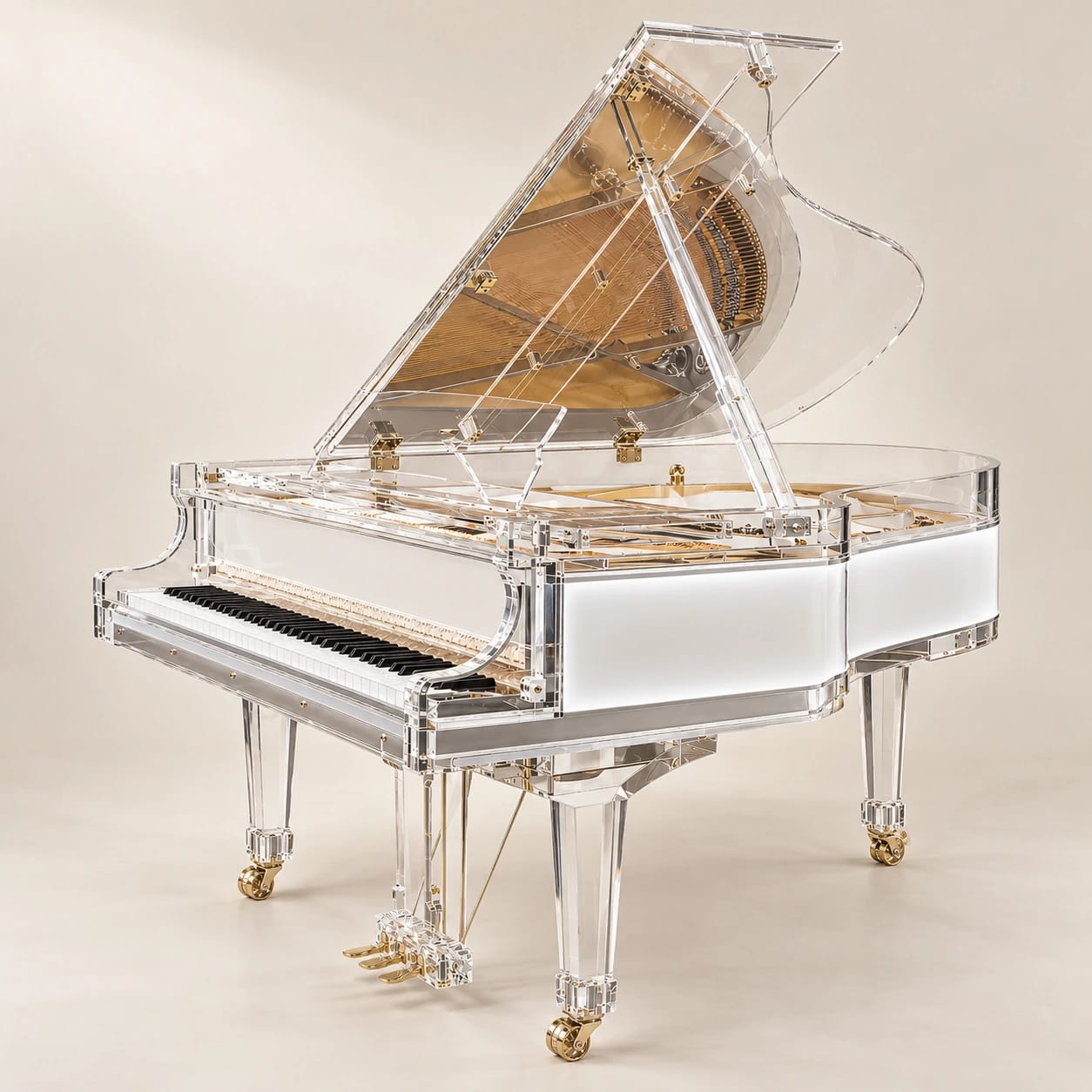
Studio visualisations. Date availability and venue arrangements are confirmed separately.
Good to know
Your questions, answered.
Should a performer specify a model or just a grand piano?
Specify the model if it is essential to acceptance, or identify the proposed model and ask the performer to consider it. A generic grand-piano request may be sufficient for some briefs, but that decision belongs to the authorised musical person. State preferences separately and do not imply that any listed model will satisfy every performance. The current collection provides a starting point for the conversation, not automatic rider compliance.
Can we ask for unusual piano preparation?
You can describe the request and ask whether it can be accommodated. Do so before booking, especially where it involves internal contact, objects, attachments or alterations. Do not assume permission from the fact that the technique is part of the performance. Record the explicit response and adjust the creative or equipment plan if necessary. Optional tuning does not by itself authorise other forms of preparation.
Does the floor plan prove that the piano will fit?
No. A drawing helps communicate the proposed position and surrounding requirements. The delivery route, stage, floor and any lift or level change still need assessment by the appropriate supplier and venue specialists. Do not use a model number, rough outline or single dimension as an access certificate. If the position changes, send the revised plan for review before anyone attempts to move the instrument.
What should be checked just before the show?
Check the accepted model, agreed preparation, first use and the current playing position against the final brief. Confirm that separate audio and accessory responsibilities have owners, and that any outstanding requirement has an explicit answer. If the performer raises a concern, describe it to the hire team and use the agreed response process. Avoid unauthorised repairs or hurried substitutions made without musical acceptance.
Let’s talk about your hire
Tell us what you’re imagining.
Tell us the occasion, the piano and the details you know. We can help work through the rest.