For corporate event teams
Piano hire for corporate event and office managers
Coordinate grand piano hire across your event, facilities and approval teams. Share the programme, proposed instrument and building details so we can work through the booking scope and practical handover with you.
Black, white and clear grand pianos. We confirm availability and arrangements for each booking.

At a glance
What matters for your hire.
Create one shared scope covering the event purpose, named piano, dates, location, access, preparation and collection. Separate the budget approver, musical decision-maker, building contact and on-site coordinator. Ask Piano Hire Australia about the specific proposal, then use the current booking or quote and terms for commercial approval. Keep requested items distinct from accepted inclusions, and give the delivery and collection roles a concise operational handover before the event owner steps away.
The collection
Find your grand piano.
Explore the instrument as well as its finish. We can talk through the right option for your plans and dates.

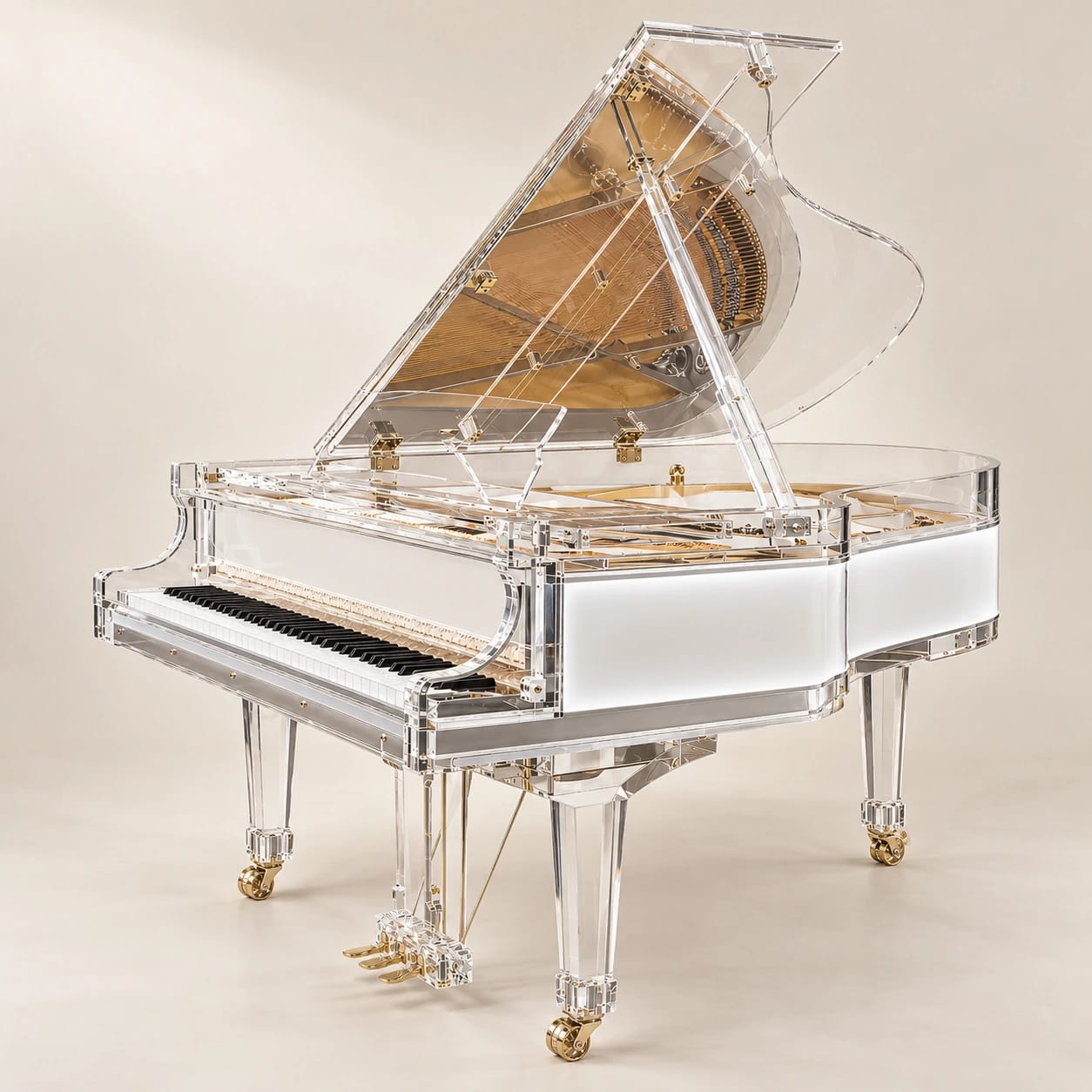
Studio visualisations. Date availability and venue arrangements are confirmed separately.
At a glance
Move from internal request to accountable handover
Define the event scope
State use, dates, location, model and requested services.
Assign decision roles
Separate budget, musical, building and on-site responsibilities.
Obtain specific responses
Resolve model acceptance, access assessment and supplier scope.
Complete commercial approval
Match current booking documents to internal requirements.
Hand over and close
Issue the operational note and retain responsibility through collection.
Let’s talk about your hire
Have a date or venue in mind?
Tell us the occasion, the piano and the details you know. We can help work through the rest.
The practical details
Plan your hire with confidence.
Explore the parts that matter to your plans. If you’re unsure, we can talk them through with you.
A little more about this hire
Booking a grand piano for a company event can cross several teams. An office manager may hold the budget, an event producer may write the programme, facilities may control the building and an external musician may make the instrument decision. The booking is easier when those responsibilities are visible before an enquiry is sent.
This page is for the person coordinating that internal workflow. It focuses on gathering a reliable brief, securing the right approvals, confirming the supplier scope and handing the plan to the on-site team. It does not promise that a purchase order, building booking or internal sign-off automatically confirms a piano hire.
Explore the topics on this page
Define the request before asking for a budget approval
Start with what the organisation wants the piano to do. It may support an employee event, accompany a performer, form part of a reception or be used for a particular presentation moment. Describe the actual activity and the first required use. A procurement line saying only “piano hire” leaves too much room for different assumptions.
Read the detail about Define the request before asking for a budget approval
Identify the event date, venue address and room, and mark anything provisional. If the programme or location is still changing, explain the options rather than presenting an early preference as a settled scope. The supplier can respond more usefully when it is clear which facts are fixed and which decisions remain open.
List the requested services alongside the instrument: transport and placement arrangements, collection and optional on-site tuning where wanted. Keep musician engagement, audio production and other event services separate unless specifically agreed. A complete scope does not mean everything comes from one supplier; it means every required item has an owner.
Use this initial brief for internal discussion before seeking a final amount. It helps the budget approver understand what is being purchased and prevents a later access or schedule requirement from appearing to be an unexplained addition. The current booking or written quote should establish the actual cost and inclusions.
Give the scope a clear decision status. A draft request, a supplier response awaiting approval and an accepted booking are different stages. Marking them explicitly helps a colleague joining the project understand whether they are authorised to proceed or simply reviewing an option. Do not let a polished internal document imply that the supplier has accepted details it has not yet seen.
When comparing proposals, use the same known requirements and leave unanswered items visible. A lower amount may describe a different period or fewer services; a longer inclusion list may still leave the building assessment unresolved. The procurement task is to understand the actual scope, not to make every response appear equivalent by filling gaps with assumptions.
Before moving from approval to implementation, ask the booking owner to reconcile the documents once. The accepted instrument, dates, location, services and collection should agree across the supplier record and internal event brief. If they differ, resolve the discrepancy before handing the plan to the on-site team. This single check is more useful than circulating several versions and expecting the delivery coordinator to decide which one controls. It also leaves the organisation with a clear basis for reviewing later changes without treating every operational request as automatically within the original approval.
Map the decision roles without creating a committee
Nominate one booking owner who keeps the current scope and communicates with the hire team. That person can gather input from others without requiring every stakeholder to contact the supplier independently. The aim is a clear channel, not a new layer of administration.
Read the detail about Map the decision roles without creating a committee
Separate the main decisions. The budget approver authorises expenditure; the performer or musical representative accepts the instrument where necessary; the venue or facilities role supplies building information; and the on-site coordinator manages the practical handover. One person may hold several roles, but the responsibilities should still be explicit.
Agree who can approve a change after the initial booking. A room change, extra hire day or different model can affect more than one team. The booking owner should know when to return to the budget approver, musician or facilities contact rather than treating every change as a minor operational choice.
Use role names in shared planning notes and keep personal contact information within the appropriate event and booking channels. The brief builder does not need staff names, email addresses or phone numbers. Its purpose is to show which role owns each decision so the organisation can make a clean handover when people are absent.
Obtain musical acceptance of the named instrument
Piano Hire Australia's current collection includes Gordon, the white Stenberg 152; Sebastian, the black Yamaha C3; and Oscar, the clear Teschendorf M170. Identify the exact model in the request. A budget approval for a generic grand does not resolve a performer's specific requirement or a visual concept tied to a particular instrument.
Read the detail about Obtain musical acceptance of the named instrument
Ask the performer to separate essential requirements from preferences. Send any relevant rider extract or preparation question to the hire team and obtain a specific response. Do not assume that a general booking confirmation accepts every instruction in an attachment or guarantees a particular musical result.
The event's design team may also have a finish preference. Record it alongside the musical requirement without letting one silently replace the other. If a different model is proposed, seek the relevant acceptance rather than having the booking owner guess whether it is equivalent for the programme.
Optional on-site tuning can be requested through the hire process. Coordinate it with the first required use and the venue schedule. Performer services, microphones, reinforcement and audio operators should have separate owners unless an explicit agreed scope states otherwise.
Advance the building with the people who control it
Ask facilities or the venue for the actual loading location and route to the event room. Include stairs, lifts, stage access, level changes and any building restrictions relevant to the proposed delivery. A staff member knowing the building well does not replace the information the moving specialists need to assess the instrument route.
Read the detail about Advance the building with the people who control it
For an office event, distinguish permission to hold the function from approval of the delivery and placement proposal. The event organiser may control the guest list while another team controls loading access, lift booking or after-hours entry. Ask the responsible role for the actual requirements and pass them to the hire team.
Provide current plans or photographs where useful, but do not turn them into a fit certificate. This page makes no doorway, floor-load, stage or lift suitability promise. The appropriate venue and supplier specialists must assess their respective parts. Do not propose staff movement of the instrument as a workaround for an unresolved access issue.
Include collection in the building advance. The people available during setup may not be present after the event, and the route may be used differently during pack-down. Identify the role who can provide access for the agreed collection and make sure they receive the final operational details.
Translate the quote into an accurate internal approval
Use the current booking or written quote as the source for the amount, dates and inclusions. Check that it matches the event brief before submitting it for internal approval. A quote for one room or hire period should not be used to approve a plan that has already changed.
Read the detail about Translate the quote into an accurate internal approval
If your organisation needs an invoice reference, purchase order or a particular administrative step, raise that requirement early. Do not assume the supplier accepts an internal process as payment or booking confirmation. Ask what is required to complete the hire and retain the actual confirmation once those steps are satisfied.
Keep requested items separate from accepted scope. An email asking for late collection, an additional tuning or another location is not evidence that the service has been included. The booking owner should reconcile those requests with the supplier's response before telling the event team that the arrangements are settled.
Review the current hire terms through the organisation's normal approval process. If a question affects the decision, ask before confirming. This guide does not provide a substitute contract, a standard company-event price or a promise about cancellation, changes or payment methods beyond what the current accepted documents state.
Build a run sheet that respects supplier dependencies
Place the requested delivery, placement, optional tuning, performer check, soundcheck and first event use on separate lines. Ask the supplier what can be confirmed, then use those arrangements in the final run sheet. Avoid assigning all preparation to one vague “setup” period that hides competing tasks.
Read the detail about Build a run sheet that respects supplier dependencies
Coordinate other suppliers around the agreed route and position. Furniture, catering, staging and audio equipment should not block specialist movement. The on-site coordinator's role is to provide access and communicate the current plan, not to direct a piano-moving technique or recruit general event staff to handle the instrument.
Online booking requires at least two days' notice. That is a minimum booking rule, not a guarantee that every model or timing request can be arranged at short notice. If the event is urgent or depends on a narrow access period, state the actual constraint in an enquiry and wait for confirmation.
If the programme changes, identify which supplier dependency is affected. A speech moving later may not change the hire, while a new room, extra rehearsal day or revised collection date may. Send specific changes to the hire team rather than assuming the whole supplier schedule follows the latest internal run sheet automatically.
Hand over the event without handing over confusion
Prepare a concise operational note for the on-site coordinator. It should name the instrument, room, agreed position, preparation sequence, first required use and collection arrangement. Add any unresolved point with its responsible role. Do not make the coordinator reconstruct the plan from a long thread of quotes and provisional requests.
Read the detail about Hand over the event without handing over confusion
Keep the commercial record separate from the operational handover where practical. The venue or crew needs the relevant arrangements, not necessarily the organisation's payment details or every approval discussion. Share information according to the actual task while ensuring the booking owner can retrieve the accepted documents if a question arises.
Identify a backup role if the event owner becomes unavailable. That person should know how to contact the hire team through the agreed channel and which changes require renewed approval. A backup is useful only if they have the current scope, not just a calendar invitation saying a piano is arriving.
After the event, ensure someone remains responsible through collection. A successful performance is not the end of the hire workflow. Keep the route available, report any concern appropriately and record any accepted variation. The organisation can then close its own administration against the actual completed arrangement.
Maintain a reusable brief without assuming every event is identical
A reusable internal template can save time, but copy the questions rather than last year's answers. Dates, room layouts, instrument availability and service arrangements need current confirmation. A previous delivery does not automatically approve another route, building position or collection schedule.
Read the detail about Maintain a reusable brief without assuming every event is identical
Keep the useful decision structure: purpose, model acceptance, venue access, preparation, commercial approval and handover. For each new event, ask what has changed and what still needs a response. This makes the process repeatable without turning it into a blanket assumption that every company function has the same requirements.
Record actual lessons from your own event in the organisation's private notes, with appropriate permission for any later public use. This page does not invent client examples or claim experience at your office. The general workflow is a planning aid, while the facts of each hire belong in its own confirmed record.
Use the builder on this page to create the first version of the scope and responsibility note. It does not submit a purchase request, reserve a piano or approve building access. The next step is to obtain the specific supplier and internal responses, then keep the accepted version ready for the people delivering the event.
Want to organise your notes first?
Your enquiry
Corporate piano booking brief
Create a reusable scope and responsibility note using role names only. It does not submit a purchase order or make a reservation.
Your notes stay in this page. Nothing is sent or saved automatically.
0 / 4,000 enquiry-note characters. Only answered fields and selected checks are included.
Read or select your brief
Corporate piano scope and responsibility brief

Event purpose and first use: To confirm
Dates and location status: To confirm
Instrument and musical acceptance: To confirm
Building and access owner: To confirm
Requested services and sequence: To confirm
Commercial approval roles: To confirm
On-site and collection handover: To confirm

Planning checklist
[ ] One booking owner holds the current scope
[ ] Musical acceptance and visual preference are distinct
[ ] Building role supplies current access information
[ ] Requested services matched to confirmed inclusions
[ ] Internal approval matches the current quote or booking
[ ] Run sheet separates preparation tasks
[ ] On-site coordinator has a concise operational handover
[ ] Responsibility continues through collection
[ ] New events refresh facts rather than copying old assumptions

Planning notes only. Piano availability, access and arrangements need confirmation before booking.
Good to know
Your questions, answered.
Can we treat a purchase order as confirmation of the piano booking?
Do not assume an internal purchase order or approval completes the supplier’s booking process. Tell the hire team what your organisation requires and ask what steps are needed to confirm the instrument and arrangements. Keep the actual supplier confirmation with the accepted scope. An internal budget commitment and a confirmed hire are different records, even when they refer to the same event.
Who should approve the instrument if an external pianist is performing?
Ask the performer or their authorised musical representative to consider the exact proposed model and any preparation requirements. The office manager can coordinate the decision without making the musical judgement on their behalf. If a different model is proposed later, obtain any necessary renewed acceptance. Keep visual preferences from the event team separate from essential performer requirements so the supplier receives an unambiguous brief.
What should facilities provide for the access assessment?
Ask for the actual loading point, complete route, room and proposed position, with current information about stairs, lifts, stages, level changes and restrictions. Include collection access as well as delivery. Plans and photographs can support the discussion, but they do not themselves certify fit or capacity. The responsible venue and moving specialists need to assess the specific proposal using the information they require.
Can we reuse the same plan for our next company event?
Reuse the structure and questions, then refresh the actual answers. Confirm the date, named instrument, room layout, access, preparation and collection for the new event. A previous booking does not reserve stock or approve a changed route. Keep any genuine lessons in your own records, but do not let a copied template turn last year’s arrangements into assumptions about the current hire.
Let’s talk about your hire
Tell us what you’re imagining.
Tell us the occasion, the piano and the details you know. We can help work through the rest.