For event planners
Piano hire for event planners: manage the brief and handovers
Bring the piano hire into your event plan with a clear instrument, venue and schedule brief. Talk with us about the proposed use, preparation and handovers for the event you are coordinating.
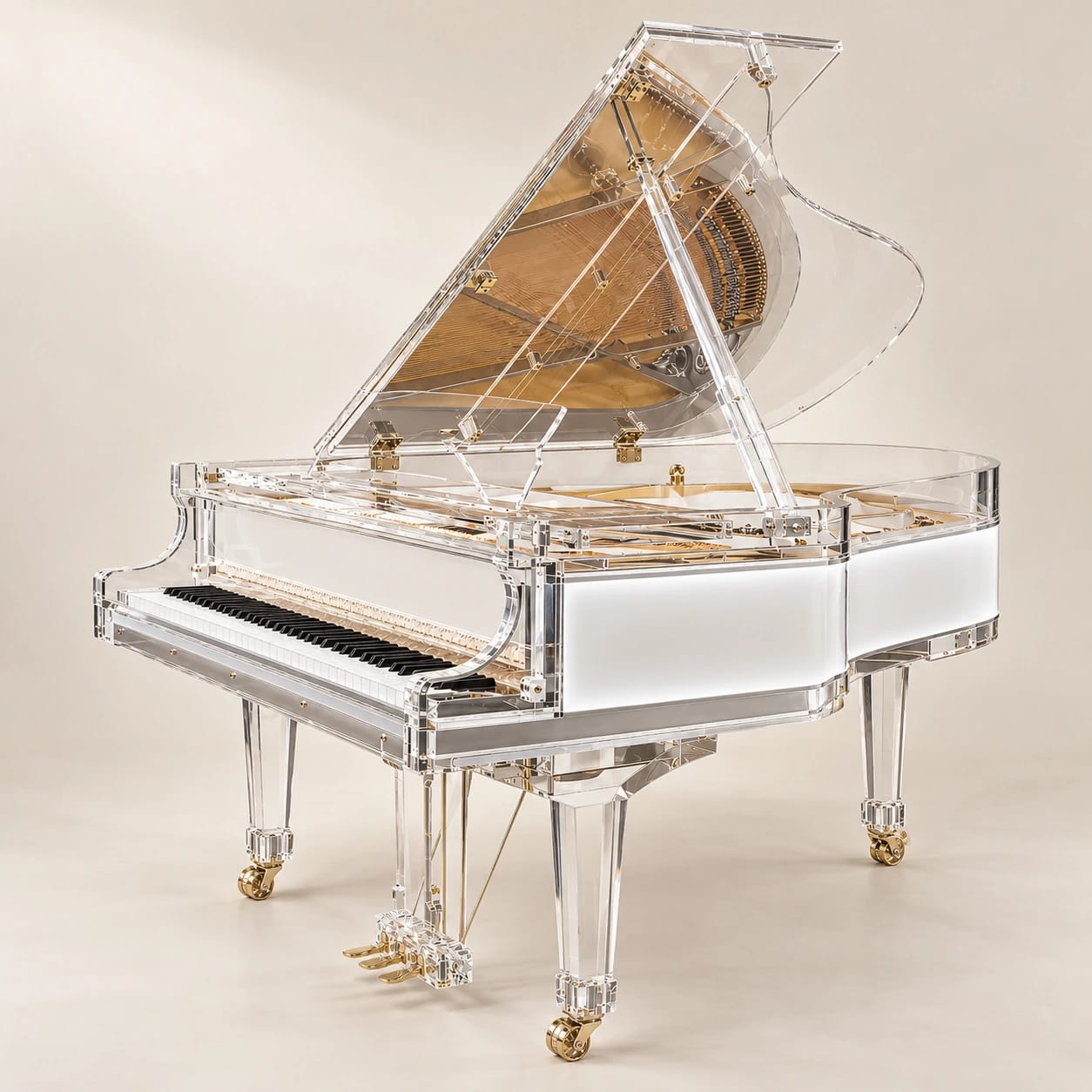
Black, white and clear grand pianos. We confirm availability and arrangements for each booking.
At a glance
What matters for your hire.
Use one current piano brief with named decision roles, a defined instrument and use, venue permission, route evidence, first readiness and collection requirements. Track requests separately from confirmations, compare complete scopes and manage material changes explicitly. Give each on-site role the part of the accepted plan it needs.
The collection
Find your grand piano.
Explore the instrument as well as its finish. We can talk through the right option for your plans and dates.


Studio visualisations. Date availability and venue arrangements are confirmed separately.
At a glance
Keep the client idea connected to accepted arrangements
Define the requirement
Separate the client’s purpose, preferences and essential needs.
Assign decision owners
Identify who confirms instrument, venue and programme questions.
Resolve dependencies
Connect route evidence, first readiness and collection.
Control revisions
Track requests separately from accepted changes.
Hand over and close
Give each role a current instruction and complete the collection plan.
Let’s talk about your hire
Have a date or venue in mind?
Tell us the occasion, the piano and the details you know. We can help work through the rest.
The practical details
Plan your hire with confidence.
Explore the parts that matter to your plans. If you’re unsure, we can talk them through with you.
A little more about this hire
An event planner often connects several people who each hold one necessary answer. The client approves the experience, the performer defines playing requirements, the venue controls the premises and the supplier assesses the instrument arrangement. The planner’s task is to make those answers form one workable booking rather than a collection of individually reasonable but incompatible requests.
This guide provides a professional coordination workflow for that task. It focuses on decision ownership, scope, dependencies and handovers. The general event checklist covers the preparation items; this page explains how a planner keeps them current across a client project.
No venue affiliation, supplier package or previous event is implied. Instrument availability, access, timing and requested services must be confirmed for the actual proposal. The workflow is designed to make that confirmation easier to manage, not to let the planner approve physical arrangements on another party’s behalf.
Explore the topics on this page
Turn the client’s idea into a defined requirement
Ask what the piano should contribute to the event. A performance, a visual feature and a photographic moment may share an instrument but create different requirements. Record the purpose in language the client recognises, then identify the practical details needed to assess it. Avoid beginning with a fixed delivery instruction before the actual use is understood.
Read the detail about Turn the client’s idea into a defined requirement
Separate essential requirements from preferences. The client may care most about the finish, while the performer may have a specific instrument requirement. A preferred position may be flexible if it conflicts with another part of the room. Make those distinctions visible so the discussion can focus on what truly cannot change.
Use the current collection to identify the real model being considered. Do not treat a generic reference image or a previous supplier’s instrument as a specification for this booking. If the programme depends on one particular model, state that before the event plan relies on it and wait for availability confirmation.
Assign one owner to each outstanding decision
Create a short decision list with the question, the role that can answer it and its current status. The client may decide the visual option, the performer the playing requirement and the venue the room permission. The business confirms its own availability and arrangements. This prevents a question from circulating indefinitely among people who cannot resolve it.
Read the detail about Assign one owner to each outstanding decision
Do not collapse these decisions into a single approval tick. Client approval of an idea does not establish venue consent or physical access. A venue’s willingness to consider a piano does not reserve an instrument. Keep the stages distinct until the relevant parties have actually responded to the same proposal.
Assign one coordination lead to maintain the current brief. That role collects decisions and communicates changes, but should not infer permission or promise a supplier outcome. A useful record makes authority clear without requiring everyone involved to understand every detail of the other parties’ work.
A practical decision list can also identify what depends on the answer. Confirmation of the instrument may be needed before the performer signs off the plan; a final room configuration may be needed before the route can be assessed. These are project dependencies to discuss, not universal deadlines set by this guide. Ask the relevant party when the information is needed and record that response. If the answer is delayed, communicate the consequence to the client instead of quietly removing the condition from the brief. This makes the planner’s next action clear: obtain the missing evidence, adjust another part of the proposal or ask for an alternative to be considered. It also helps a colleague taking over the project understand why an apparently small question remains important. A decision record earns its place when it changes what the team does next, rather than merely recording that an email was sent.
Gather venue evidence before fixing the floor plan
Ask the venue for the information needed to describe the proposed room and route. Use the actual room name and configuration, and identify any partition, stage or controlled access area relevant to the event. A generic venue plan may be a useful reference but should not replace the current arrangement being booked.
Read the detail about Gather venue evidence before fixing the floor plan
Show the piano alongside the real event layout: audience, seating, production equipment and other substantial elements. Identify the proposed position and any alternatives for discussion. The planner’s drawing should communicate the event requirements, not certify physical fit or calculate structural capacity.
Keep the complete route connected to that position. Arrival access, doors, turns, changes of level and any lift or stage transition need appropriate assessment. If the venue has not supplied enough information, record the gap. A deadline is a reason to chase the correct answer, not to turn an unverified description into a confirmed instruction.
Build a dependency schedule around first readiness
Start with the first actual piano use, which may precede the public programme. Work backwards through rehearsal, requested tuning and room preparation, then identify the venue access periods that could support the sequence. Mark which requirements are fixed and which are preferred so the discussion is not driven by invented precision.
Read the detail about Build a dependency schedule around first readiness
On-site tuning is optional and should be requested explicitly. Discuss its timing in relation to room activity and rehearsal rather than assuming it is included whenever the piano is played. The actual service and appointment need confirmation for the booking; no particular technician or standing arrangement is established by the event plan.
Build the departure sequence with the same care. The final performance, guest movement, other supplier pack-down and room release may create dependencies before collection. Put those on the schedule early. A piano booking is not fully coordinated while collection remains a blank at the bottom of the running order.
Compare options without changing the assumptions silently
If presenting alternatives to the client, keep the differences explicit. You may be comparing instruments, same-day and overnight periods or different venue positions. Hold other assumptions constant where possible and show what changes in each option. This makes the decision easier to explain without pretending that two different scopes are directly interchangeable.
Read the detail about Compare options without changing the assumptions silently
Use current supplier information and complete quotes. Do not substitute a remembered rate from a previous event or assume an optional service is included because it appeared elsewhere. Venue, performer and production costs may belong to separate arrangements; keep those scopes distinct even when the client sees one overall event budget.
Label provisional options clearly. A client can select a preferred direction while availability or access remains unresolved. Record that as a preference awaiting the relevant confirmations, not as a finished booking. Return any material difference between the preferred idea and the actual offer to the appropriate decision maker before issuing final instructions.
Clarify where the piano scope meets other suppliers
Instrument hire should not carry hidden assumptions about performers, sound systems, staging or production crew. Ask each relevant supplier to describe its own scope and identify the points where coordination is needed. The planner can connect those requirements without implying that Piano Hire Australia supplies services that have not been agreed.
Read the detail about Clarify where the piano scope meets other suppliers
A performer may need information about the actual instrument and its readiness. A production team may need the position fixed before planning other equipment. The venue may need to approve the room layout and supplier access. Collect the requirements that affect the piano proposal and share the relevant information with the business rather than forwarding unrelated production material.
If a supplier’s request would change the instrument position, route or use, treat it as a change requiring assessment. A creative or technical preference does not itself establish permission to move the piano. Resolve those interfaces while the event can still adapt, rather than asking the on-site team to make an unreviewed decision under time pressure.
Manage uncertain settings and contingency proposals explicitly
If the client is considering outdoor, partly exposed or temporary-structure placement, identify that condition at the first enquiry. Ask for individual assessment. A venue’s offer of a marquee, terrace or cover should not be treated as a general suitability guarantee for a grand piano.
Read the detail about Manage uncertain settings and contingency proposals explicitly
Keep an alternative setting as a separate proposal with its own room, route and timing questions. Explain when the event team expects to decide between options and who will authorise the choice. Do not describe an alternative as approved merely because the venue has mentioned that a room might be available.
The same principle applies to a programme that may move between spaces. If the piano would need to relocate, explain the entire sequence before booking. The planner should not assume the instrument can follow guests or be moved by general event staff. A clear contingency is an assessed arrangement, not an instruction to improvise when the preferred plan changes.
Use a change log that distinguishes request from acceptance
Record each material change with the previous detail, the proposed revision and the parties who need to consider it. Changes to the model, dates, room, position, intended use or requested services can affect different parts of the arrangement. A short comparison is more useful than issuing a new running order and expecting everyone to detect the difference.
Read the detail about Use a change log that distinguishes request from acceptance
Give each change a status such as requested, awaiting venue information or accepted. The published FAQs describe hire-time and venue changes as reviewed case by case. Sending a request does not mean it has been approved, and another supplier’s agreement does not establish the piano business’s acceptance.
Once a revision is confirmed, update the current brief and retire the superseded instruction. Keep the relevant correspondence as evidence of the accepted arrangement. This prevents the venue, performer and collection representative from arriving with different versions of the programme, each believing theirs is the final one.
Prepare role-specific handovers for the event day
The person meeting the arrival needs the confirmed room, position and access information. The performer needs the actual instrument and readiness details. The person supervising the end of the event needs the collection arrangement and relevant route conditions. Give each role a concise handover derived from the same accepted plan.
Read the detail about Prepare role-specific handovers for the event day
Keep private contacts, addresses and access details in appropriate correspondence. A role-based public planning tool can organise responsibilities without collecting that information. Review copied notes before sharing them so each recipient receives what is necessary and current, rather than a long history of discarded ideas and private messages.
Explain how unexpected requests should be escalated. On-site staff should not have to decide whether a new position is acceptable or whether an extension can be assumed. The planner’s coordination role is most useful when people know which changes require a fresh conversation and who will make that contact.
Close the event with collection and a useful factual record
Check the collection conditions before the programme reaches its final moments. Confirm that the relevant venue role is aware of the arrangement and that other supplier pack-down plans do not obscure the agreed route. Communicate changes promptly instead of asking staff to shift the instrument to solve a late conflict.
Read the detail about Close the event with collection and a useful factual record
After the hire, record useful process observations: which information was difficult to obtain, where a decision remained unclear and whether a handover needed improvement. Keep the record factual and avoid turning a planning example into a promotional case study without the necessary evidence and permission.
For the next event, reuse the structure of the brief but refresh its contents. Dates, venue conditions, instruments and people change. A completed event does not establish a standing reservation, guaranteed delivery method or automatic rate for another proposal. A good planning system makes each new enquiry clearer while preserving the need for current confirmation.
Want to organise your notes first?
Your enquiry
Build an event planner’s coordination brief
Create a role-based record of requirements and unresolved decisions. This does not reserve a piano or approve access.
Your notes stay in this page. Nothing is sent or saved automatically.
0 / 4,000 enquiry-note characters. Only answered fields and selected checks are included.
Read or select your brief
Event planner piano coordination brief

Client purpose and essential requirements: To confirm
Decision owners: To confirm
Current proposal: To confirm
Programme dependencies: To confirm
Outstanding decisions: To confirm
Change and handover plan: To confirm

Planning checklist
[ ] Separate essential requirements from preferences.
[ ] Assign an owner to each outstanding question.
[ ] Use the actual room configuration and current model.
[ ] Build arrival and collection dependencies together.
[ ] Confirm optional services explicitly.
[ ] Keep separate suppliers’ scopes clear.
[ ] Label requests until acceptance is received.
[ ] Issue role-specific handovers from one current plan.
[ ] Review collection conditions before pack-down.

Planning notes only. Piano availability, access and arrangements need confirmation before booking.
Good to know
Your questions, answered.
What should an event planner send in the first enquiry?
Send the intended use, preferred model, proposed dates, exact location privately and the main constraint. Identify what is already confirmed and which decisions remain open. The first brief can be concise; it should expose the question most likely to affect the arrangement rather than conceal it in attachments.
Can the planner approve a new piano position on behalf of the client?
Client authority is only one part of the decision. The venue and business still need to assess the physical proposal and relevant conditions. Do not treat creative approval as permission for staff to relocate the instrument or as confirmation that a new route is workable.
How should provisional options be presented to the client?
Show the current scope and label the missing confirmations. A client may choose a preferred instrument or period while availability or access remains unresolved. Keep that distinction visible and return material changes in the actual offer to the appropriate decision maker.
Does the piano booking include event production services?
Do not assume performers, sound equipment, staging or technical crew are included. Confirm each supplier’s scope and identify coordination points. Share requirements affecting the piano with the business, but do not attribute another supplier’s services or promises to the instrument hire.
What makes a useful final handover?
Use the accepted booking to give each role the information it needs: arrival and placement, performer readiness, or collection and route conditions. Identify how changes are raised. Keep superseded options out of working instructions and share private details only through appropriate direct correspondence.
Let’s talk about your hire
Tell us what you’re imagining.
Tell us the occasion, the piano and the details you know. We can help work through the rest.